

Short answer: For hot, branded takeaway food, paper bowls win on customer perception, print quality, and regulatory safety. For cold, long-hold, or ultra-low-cost applications, plastic still has a place. The right choice depends on your menu, your market’s regulations, and how much your packaging needs to sell your brand.
Head-to-Head Comparison
| Factor | Paper bowls | Plastic bowls |
| Heat handling | Good — rigid board insulates; comfortable to hold | Can soften or warp with very hot food; conducts heat to hands |
| Grease & moisture resistance | Needs a barrier coating (PE, PLA, or water-based) to hold wet food | Naturally waterproof |
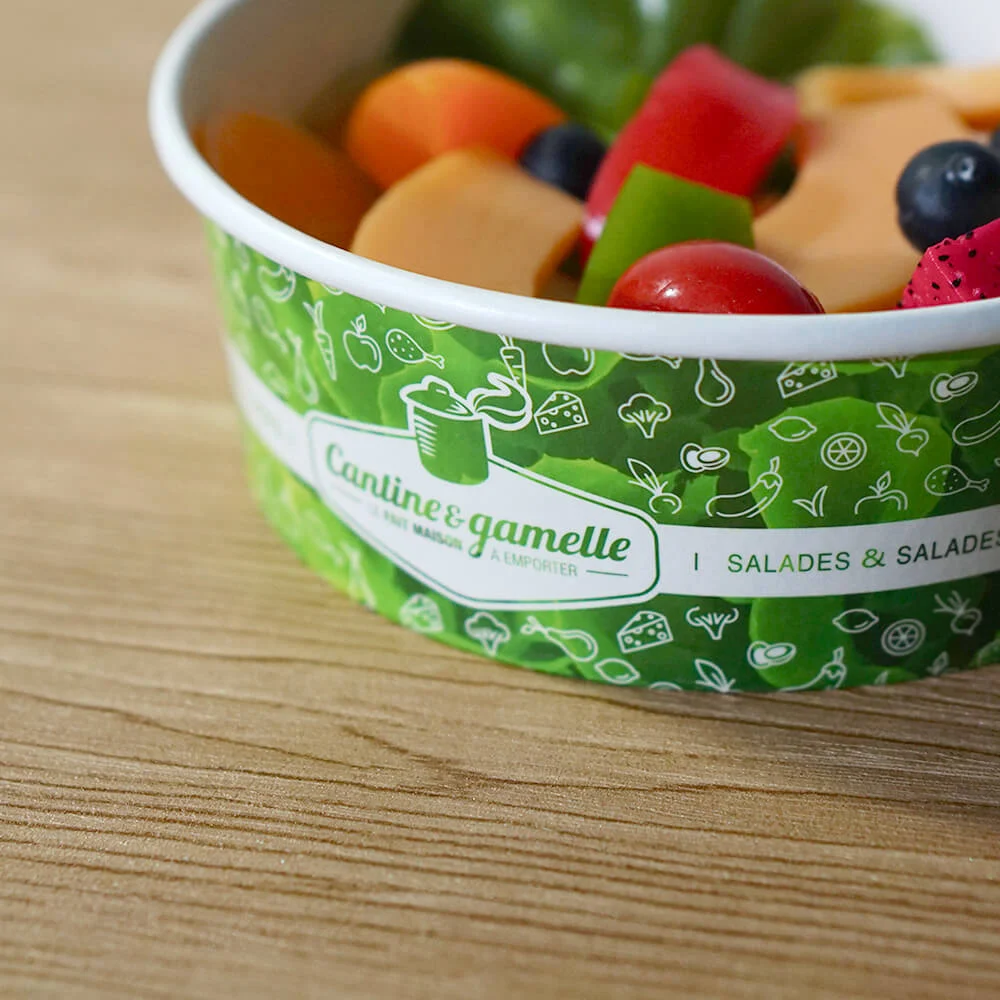
| Branding / print quality | Excellent — full-wrap, full-color custom printing | Limited — usually a label or single-color print |
| Customer perception | Premium, natural, responsible | Functional, but increasingly seen as disposable |
| End of life | Paperboard is widely recyclable where facilities accept food-contact paper; lined bowls need the right stream | Technically recyclable in some regions, but food-contaminated plastic is rarely recycled in practice |
| Regulation risk | Low — ahead of single-use plastic restrictions | Rising — bans and taxes on single-use plastics are spreading across the EU, UK, Canada, and parts of the US |
| Unit cost | Slightly higher at comparable quality | Lower at the bottom end |
When Paper Bowls Are the Better Choice
- Hot food service — noodle bowls, soups, rice bowls, porridge. Paper insulates better and won’t go soft.
- Brand-forward businesses — if your packaging is part of your marketing, full-wrap custom printing on paper is in a different league from a sticker on plastic.
- Markets with plastic restrictions — if you sell in the EU or UK, single-use plastic rules are already biting. Paper keeps you compliant by default.
- Premium positioning — customers consistently rate paper packaging as higher quality in blind perception tests run by foodservice brands.
When Plastic Still Makes Sense
- Cold, wet, long-hold items — a salad sitting in dressing for hours, or desserts with high water content, where even coated paper is working hard.
- Microwave reheating as a core use case — some plastics are designed for it; paper bowls need specific construction and testing.
- Rock-bottom unit cost — if packaging is a pure cost line and branding doesn’t matter, commodity plastic is cheaper.
Be honest about which camp your product falls into. Most takeaway operators who switch to paper do it for branding and compliance reasons — and stay for the customer response.
What Makes a Paper Bowl Actually Work
A paper bowl is only as good as its construction. The board alone won’t hold soup — the barrier coating does the work:
- PE coating — the industry standard for liquid and grease resistance.
- PLA coating — a plant-based alternative buyers ask about in markets with plastic restrictions.
- Water-based coating — an emerging option for brands pushing plastic reduction further.
All three are available from serious manufacturers (we offer all three). What matters is matching the coating to your food: a dry poke bowl and a steaming ramen place different demands on the barrier. Ask your supplier which coating they recommend for your specific menu — a good answer is specific, not “ours works for everything.”
Size and rigidity matter too. A flimsy bowl that buckles when picked up full will undo every branding gain. Request samples and test them the way your customers will use them: filled, lidded, carried, and eaten from.
The Cost Question, Answered Honestly
Paper bowls cost more per unit than commodity plastic — typically a modest premium at scale, not a multiple. What buyers often miss:
- MOQ economics — custom printed paper bowls run at MOQs like 30,000 pcs. At that volume the per-unit premium over plastic shrinks fast.
- Branding value — a full-wrap printed bowl is advertising your customer carries through the street. Price that against a sticker on plastic.
- Regulatory insurance — a plastic ban or tax in your market can erase the unit-cost advantage overnight.
FAQ
Are paper bowls really better for the environment than plastic?
It depends on the full picture — coating type, local recycling infrastructure, and how the bowl is actually disposed of. What is clear: paperboard comes from a renewable resource, paper bowls face fewer regulatory risks, and customers perceive them as the more responsible choice. Ask suppliers for specifics rather than accepting vague “eco” claims.
Will a paper bowl hold hot soup without leaking?
Yes, when properly constructed — food-grade board with an intact barrier coating, formed and sealed correctly. Always test with your actual product: fill a sample with your hottest, greasiest menu item and let it sit for your full delivery window.
Can paper bowls be microwaved?
Some constructions can; it depends on the coating and adhesives, and it must be validated against your heating time and power. Don’t assume — ask your supplier and test.
How do I switch from plastic to paper without disrupting operations?
Match your current sizes first, then run a sample round (about 7 days) with your real food, then place your first bulk order (around 30 days production). Keep one plastic SKU as backup during the transition if your operation can’t tolerate surprises.
Ready to make the switch? Get a free quote — tell us your menu, sizes, and volumes, and we’ll recommend the right board, coating, and print setup. Start with how to choose a paper bowl manufacturer or browse our product range.