
Short answer: A paper bowl resists leaks through four things working together: a coating matched to the food, a sealed side seam, board heavy enough to stay rigid when wet, and a lid that fits the rim. No single feature does the job alone. Test with your actual food, at serving temperature, for your real holding time; a water test tells you very little.
The Coating: Your First Line of Defence
The coating is the waterproof layer inside the bowl, and it must match the food. Three coatings are commonly offered — PE, PLA and water-based — and they behave differently. PE is the long-established choice for hot, oily food: it forms a tough, continuous barrier. PLA is a plant-based coating often chosen for a bio-based story; it handles most foods well but is more sensitive to very hot, oily dishes. Water-based coatings are the newest option, used where buyers want to reduce plastic content; their resistance depends on the formulation and the food.
The key point is that “leak-resistant” is not a property of a coating in general — it is a property of a coating against a specific food. Hot noodle soup, oily curry and acidic tomato sauce attack a barrier in different ways, so tell your supplier what goes in the bowl — temperature, oil content and holding time — and ask for a sample tested with that food.
The Seam: Where Most Leaks Start
The side seam — where the paperboard sheet is joined into a cone — is the most common leak point, and it is the hardest to see in a photograph. A well-made bowl has a fully sealed, heat-bonded seam with the coating continuous across the joint. A weak seam shows up as a slow weep along one line, usually after ten or twenty minutes, exactly when a delivery customer is halfway home.
You cannot judge a seam from a spec sheet. Ask the supplier how the seam is sealed, then test it yourself: fill the bowl with your hottest, oiliest dish, lid it, lay it on its side for your delivery window, and check the seam line. Test several bowls, not one — seam quality varies piece to piece.
Board Weight and Shape: Rigidity Matters
Board weight decides whether the bowl stays rigid when wet. A light board softens faster, and a soft bowl flexes at the rim — which breaks the lid seal and turns a small weakness into a spill. A heavier board holds its shape longer and keeps the rim round, so the lid stays seated. Heavier board costs more, so use it for hot, wet, long-hold food — not for dry salad eaten in minutes.
Shape matters too: a wider bowl cools food faster and puts less pressure on the base; a taller bowl keeps soup hot but concentrates pressure at the bottom seam.
The Lid: Half the Leak Story
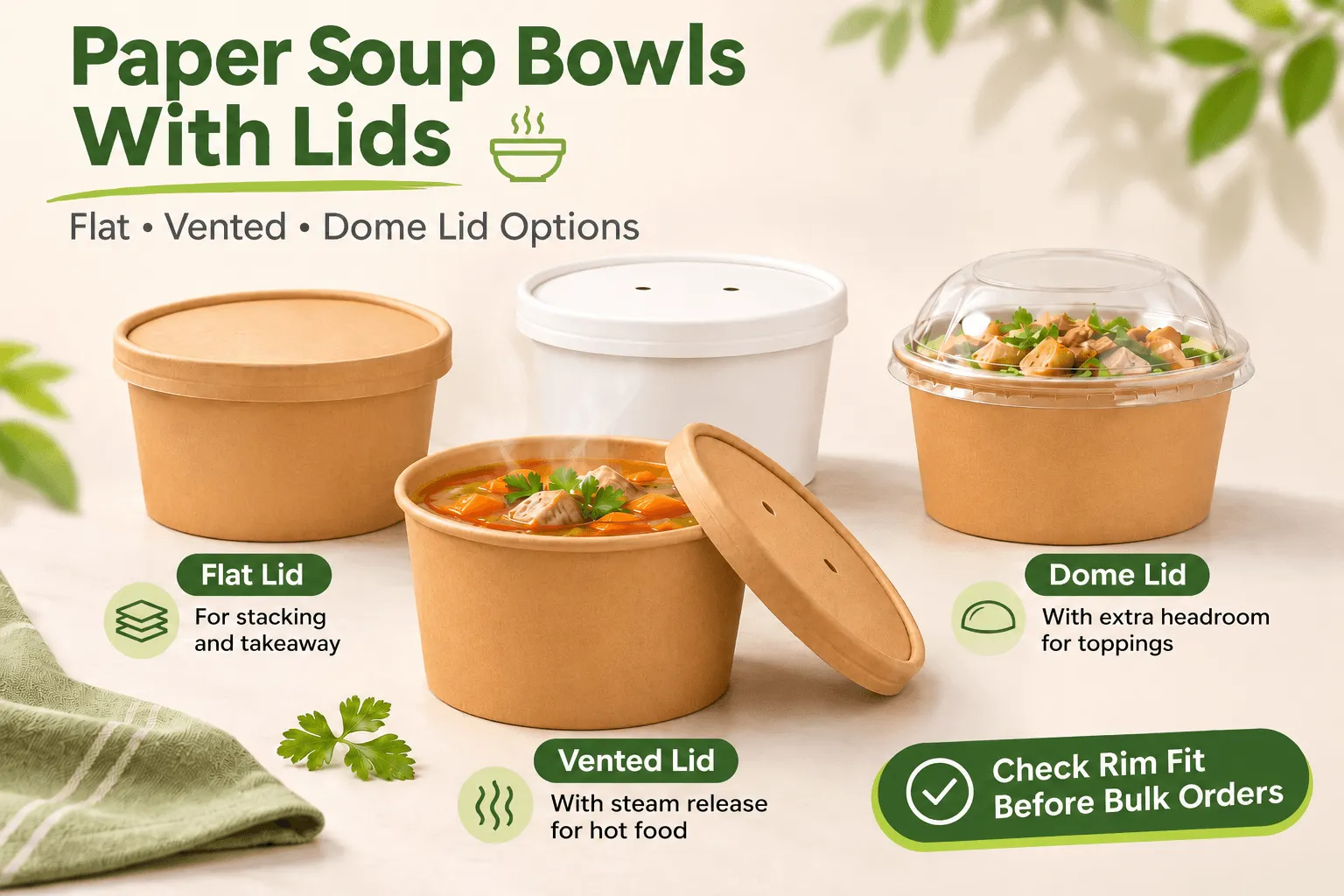
Most “leaks” reported by customers are not bowl failures at all — they are lid failures. A lid that rocks on the rim, a vent that lets soup slosh out, or a lid that pops off when the bowl is squeezed in a bag all read as a leaking bowl. Soup lids need a vent to release steam pressure, small enough that soup does not escape when tilted. Our paper soup bowls with lids guide covers lid matching in detail.
Match the lid to the bowl’s rim diameter in millimetres, not to its volume, and order lids with the bowls so one supplier owns the fit. Test the pair as customers use it: filled, lidded, carried and tilted.
How to Test Before You Order in Bulk
A proper leak test costs a week and saves an order. Samples take about 7 days; run this routine on them:
- Fill with your actual food at serving temperature — not water, not cold soup. Oil and heat change everything.
- Lid it and hold it for your real holding time — the longest gap between cooking and eating, not the average one.
- Tilt and lay it down for the delivery window, then check the seam line, the base and the lid edge.
- Repeat on several bowls. One good bowl proves nothing; five good bowls from the same batch start to mean something.
- Test again after a change. A new coating, a new size or a new supplier means a new test — leak resistance does not transfer between specs.
Bulk production runs about 30 days after sample or order confirmation, and custom printed bowls carry an MOQ of 30,000 pcs per size and artwork — so a leak found after bulk is a 30,000-piece problem. Test first. See our disposable paper bowls guide for the size ranges.
FAQ
Are paper bowls leak-proof?
No paper bowl is leak-proof in every situation — the honest claim is leak-resistant against a specific food, temperature and holding time. A bowl that holds salad all afternoon may still weep under hot, oily soup after twenty minutes. Test with your actual food before ordering in bulk.
Which coating is best for leak-resistant paper bowls?
For hot, oily food, PE is the usual choice — it forms a tough, continuous barrier. PLA suits lighter dishes and a bio-based story; water-based coatings depend on formulation. Ask your supplier to test with your dish rather than choosing by coating name alone. Our coating comparison compares the three.
Why do paper bowls leak at the seam?
The side seam is where the paperboard sheet is joined, and it is the hardest part to seal perfectly. A weak or incomplete heat bond lets liquid weep along the seam line, usually after ten or twenty minutes. Test several sample bowls on their sides with your actual food to catch it before bulk.
How do I stop soup bowls leaking in delivery?
Use a bowl with a coating matched to the soup, a vented lid fitted to the rim in millimetres, and a test routine that mirrors delivery — filled, lidded, tilted and left on its side for the delivery window. Order lids with the bowls so one supplier owns the fit.
Need a bowl that holds your soup? Get a free quote — tell us your dishes, temperatures and holding times, and we’ll confirm coating, board and lid per size, with samples in about 7 days. Browse the soup bowls and use our quote preparation checklist to get an accurate quote first time.